NC Conservation Tax Credit: How Landowners Can Save by Protecting Their Land

North Carolina landowners have more time to take advantage of a valuable incentive that can lower their state taxes while permanently protecting their farms, forests, and other natural lands.

The Conservation Tax Credit has been extended until 2030, giving more families the opportunity to explore whether it fits their land and financial goals.

The North Carolina Conservation Tax Credit rewards landowners who choose to preserve farmland, forestland, wildlife habitat, and other valuable landscapes. The program provides a state income tax credit of up to 25% of the fair market value of donated land or conservation easements. That means landowners can receive a tax break worth up to $250,000 for individuals and $500,000 for C Corporations when they permanently donate qualifying property. Credits received may vary depending on the number of qualified applicants.
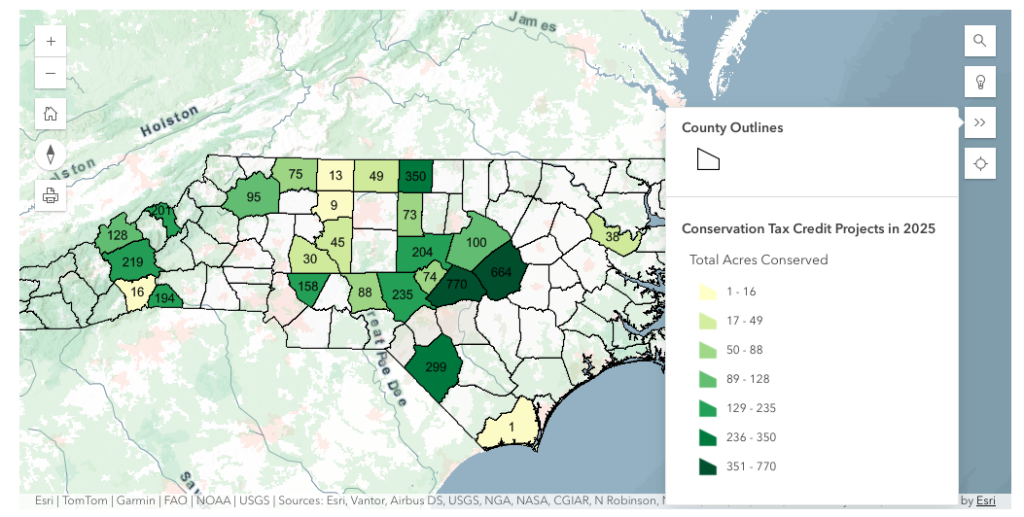
See the impact across North Carolina in our interactive map

This isn’t just good for landowners; it’s good for North Carolina. For thirty years, from 1983 to 2013, this program helped protect over 262,000 acres across our state. It was a smart investment, too: for every dollar in tax credit issued, at least six dollars’ worth of critical land in North Carolina was conserved. Now, thanks to action from the General Assembly, the program is back for qualifying donations made through 2030.

In 2025, the first year of its return, the credit helped conserve 4,128 acres across 25 counties in North Carolina, providing a variety of public benefits. Out of the acres conserved in 2025, 3,318 acres were for forestland and farmland preservation, 801 acres were for fish and wildlife conservation, and 9 acres were preserved for historical landscape conservation.

As a proud member of the Land for Tomorrow coalition, our organization helped advocate for the return and continuation of this tax credit. Alongside fellow conservation partners from across the state, we worked to show lawmakers how this program supports farmers, strengthens local economies, and protects the lands and waters that make North Carolina so special. We’re proud to have played a part in bringing this critical tool back to life.

Turning Conservation into a Legacy

Scott McNeely is a landowner from Western North Carolina who has permanently protected three properties through conservation easements. He received a Conservation Tax Credit in 2025, the program’s most recent application cycle. Land conservation is important to him and his family, who enjoy North Carolina’s natural spaces.

“I’m an avid hunter and fisherman, an outdoors person, and my wife is a horse fanatic, and so I think it’s very important that we preserve as much farmland or woodland in a natural state as we can, and have those places in the future, because if we don’t protect them now, they’ll be gone,” he said.

The conservation tax credit helped him preserve the land he so loves, and he believes that it is a great way for other landowners to do the same.

“I think the tax conservation credit is a great benefit to the entire public in North Carolina, not just the individual landowners, because if it motivates somebody to take action, then that’s one more piece of property that’s going to be more green space, whether it be for wildlife or visual pleasure,” he said.

What Is the North Carolina Conservation Tax Credit?

The Tax Credit offers a state income tax credit for donations of land or conservation easements made in perpetuity for conservation purposes, such as preserving working farmland, forestland, wildlife habitats, historic landscapes, or providing public access to trails. A landowner interested in the tax credit would begin by contacting a local land trust or nonprofit qualified to accept land donations and assist with the process. The NC Department of Natural and Cultural Resources (NCDNCR) must certify the land as providing a public benefit before the NC Department of Revenue approves a tax credit. The North Carolina Natural Heritage Program has set up a webpage with details: Conservation Tax Credit | NHP.

Who Can Benefit from the Conservation Tax Credit?

Donations must be made in perpetuity and serve a recognized conservation purpose, such as preserving working farmland or forestland, supporting wildlife conservation, protecting historic landscapes, or providing public access to trails. Special provisions also apply to floodplain protection in counties affected by recent natural disasters, as well as to land that buffers military bases and training areas.

Importantly, the program isn’t first-come, first-served. All eligible, certified applications received for a given year will be considered together, and tax credits will be distributed proportionally if the total demand exceeds the $5 million annual program cap. Donations of farmland and forestland will receive priority consideration for the first $3.25 million in credits each year.

It’s important to know that: All approved applications from the same year will be reviewed at the same time. If the total amount of tax credits requested exceeds the $5 million limit for the year, each person will receive a smaller share of the remaining credits. Donations of farmland and forestland will be given priority for the first $3.25 million in tax credits each year.

Understand the Conservation Tax Credit process with this 2-pager 

How to Apply for the NC Conservation Tax Credit

Donations made at any time in a year are eligible, as long as certification applications are submitted by January 15 of the following year and tax credit applications are filed by April 15 of the following year. Approved credits can then be used starting in the following tax year, which is filed two years after the donation is made.

While the program cannot guarantee the exact percentage of tax credit a landowner will receive, as this depends on the number of applicants, every certified donation will be awarded some level of credit. Protecting land is a reward in itself. You’re preserving something real, lasting, and beneficial to your community and our state for generations to come.

To learn more, contact the state program at ctc@dncr.nc.gov. Applications and detailed guidance are available on the NC Natural Heritage Program website. Visit this page for details: Conservation Tax Credit | NHP.

The Conservation Tax Credit is a chance to do something big – for your land, for your family, and for North Carolina. Let’s make the most of it.

Quick Facts:

  • North Carolina’s Conservation Tax Credit offers a state income tax credit for donations of land or conservation easements made in perpetuity for conservation purposes, such as preserving working farmland, forestland, wildlife habitats, historic landscapes, or providing public access to trails. Additional benefits apply to properties that protect floodplains in disaster-affected counties or buffer military installations. All donations must be permanent and meet state eligibility criteria to qualify.
  • The North Carolina Conservation Tax Credit allows landowners to claim up to 25% of the fair market value of the donated land or easement.
    • Individuals can receive up to $250,000
    • C Corporations can receive up to $500,000
  • All approved applications from the same year will be reviewed together. It is not first-come, first-served.
  • If the total amount of tax credits requested exceeds the $5 million limit for the year, each person will receive a smaller share of the remaining credits. Donations of farmland and forestland will be given priority for the first $3.25 million in tax credits each year.
  • Land and easement donations made any time in 2025 are eligible for the tax credit.
    • Application forms available in mid-July of each year
    • Certification deadline: January 15, the following year
    • Tax credit application deadline: April 15 the following year
    • Get detailed information: Conservation Tax Credit | NHP

Need help donating a conservation easement? Contact Your Local Land Trust!

To learn more, email the state program at ctc@dncr.nc.gov.


DISCLAIMER: This blog post is intended for general informational purposes only and does not constitute legal or tax advice. Landowners considering a donation of land or conservation easement should consult with a qualified tax advisor to understand the full implications of their donation and eligibility for the North Carolina Conservation Tax Credit. N.C governs the credit. General Statutes § 105-153.11 (for individuals) and § 105-130.34 (for C Corporations). Each land donation is unique, and eligibility, valuation, and final credit amount may vary based on individual circumstances and annual statewide limits.

Protect Investments, Support Rural Economies, and Preserve North Carolina’s Way of Life

North Carolina’s natural places and working farms are an important part of our way of life. They provide us with clean water and habitat for fish and wildlife. They are also economic engines that drive job creation, tourism, and local business growth.

Over 20 million people enjoy our NC State Parks annually. In Western North Carolina alone, the Made X Mountains Partnership reported that outdoor recreation generated $4.9 billion in economic impact, supported 48,000 full-time jobs, and contributed $197.5 million in local tax revenue across 25 counties prior to Hurricane Helene.

Conserving our land is not just about preserving nature for future generations—it’s about protecting investments, supporting rural economies, and preserving North Carolina’s way of life. Land for Tomorrow recommends strategic investments to safeguard our working farms, natural areas, and outdoor spaces—ensuring we’re ready to meet the current and future needs of our growing population.

Strengthening Conservation Trust Funds:

  • Additional $2 million (recurring) for NC Land and Water Fund (NCLWF)
  • Additional $2 million (recurring) for Parks and Recreation Trust Fund (PARTF)
  • Additional $10 million (recurring) for Farmland Preservation (ADFPTF)

Long-Term Recovery and Resilience:

  • $25 million (non-recurring) for local parks and greenway restoration and rebuilding (PARTF)
  • $25 million (non-recurring) for flood resilience grants (NCLWF)
  • $12.5 million (non-recurring) for farmland and working forest easements (ADFPTF)

Strengthening Conservation Through Policy:

  • Enhancing the Conservation Tax Credit
  • Supporting Farmland Preservation through Present-Use Value (PUV)

DOWNLOAD OUR 2025 BUDGET PRIORITIES HANDOUT

To learn more about the impact of the conservation trust funds and see your tax dollars in action, follow Land for Tomorrow on Facebook – https://www.facebook.com/L4TNC – and Twitter – https://twitter.com/land4tomorrow – as well as LinkedIn – https://www.linkedin.com/company/land-for-tomorrow.

Land for Tomorrow is a statewide coalition of community leaders, conservation, and wildlife organizations, and parks and recreation advocates with a common goal: increasing land and water conservation in North Carolina.

Meet The Members Working to Support the Conservation Trust Funds

Representative Ross Receives Award as a Land and Water Champion

BURLINGTON —The North Carolina Land for Tomorrow Coalition has recognized Representative Steve Ross as a 2024 North Carolina Land and Water Champion.

“Thank you, Representative Ross, for your years of service protecting the natural beauty of North Carolina,” said Piedmont Land Conservancy Executive Director Kevin Redding, who chairs the Land for Tomorrow Coalition.

Representative Ross was a critical leader in passing legislation NC Farm Act, SB 355, to reinstate NC’s conservation tax credit during the 2024 session of the NC General Assembly. The legislation passed unanimously 104-0 in the House and 40-0 in the Senate. The conservation tax credit is a time-limited state tax credit on the value of real estate donated to a qualified nonprofit or government entity for farmland preservation, public trails, fish and wildlife, and other conservation-related purposes.

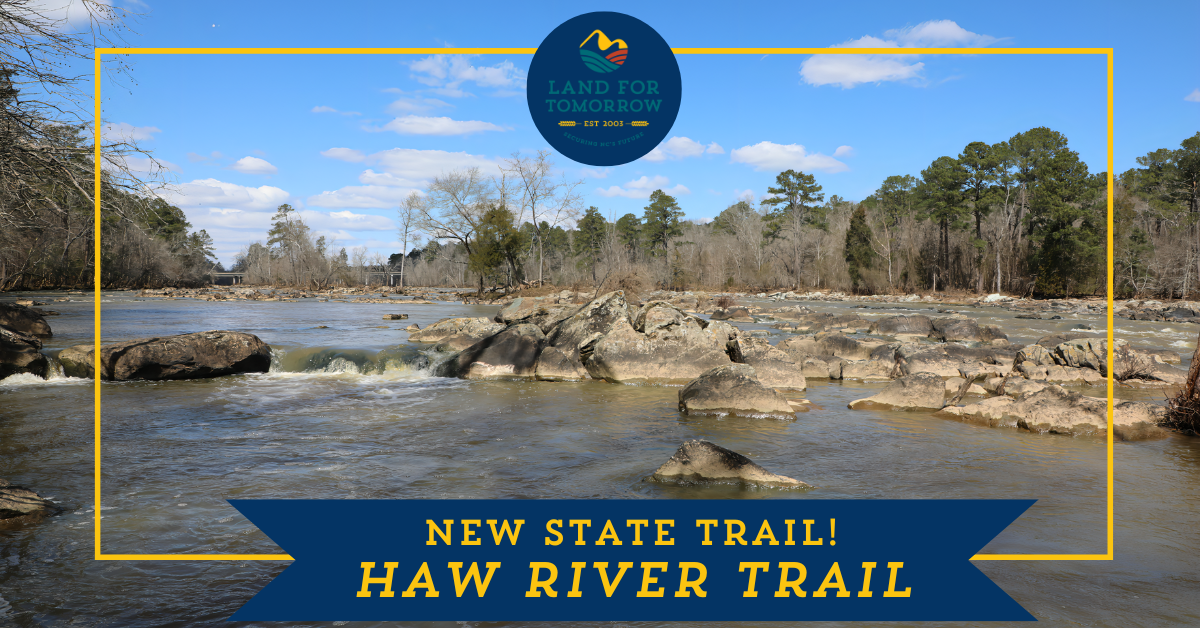
Representative Ross championed the designation of the Haw River Trail State Trail in 2023. The Trail winds through Alamance and Chatham Counties. Its over 60 miles of land and paddle trail allow the community to explore while helping to conserve and protect this vital resource.

“Rep. Ross’s tireless efforts support our farmers, enhance our natural resources, and ensure a healthier, more sustainable future for all North Carolinians,” said Redding. “The conservation tax credits are a powerful incentive for private landowners to conserve more farm and forest land and expand our state’s parks, trails, and wildlife areas. Investing in places like the Haw River State Trail ensures that residents can enjoy and explore all North Carolina offers.”

Representative Ross is one of three legislators to receive this year’s award. Other awards went to Senator Brent Jackson and Representative Michael Wray, who have been pivotal in creating more places for North Carolinians to recreate and enjoy our natural spaces.

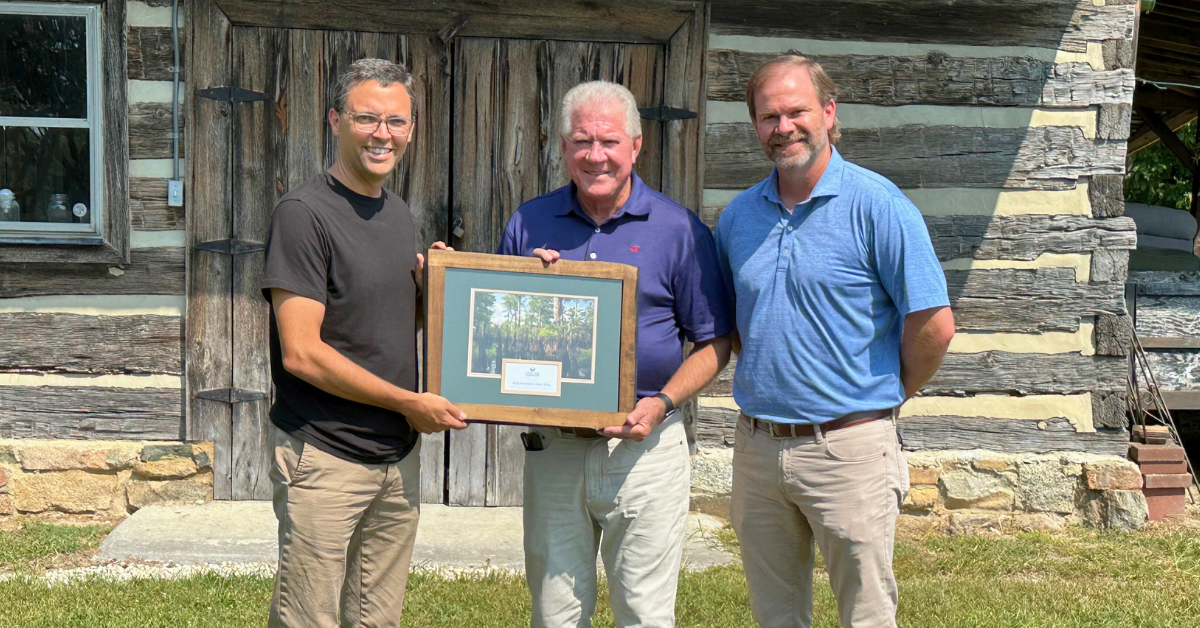
Picture Caption: Land for Tomorrow Coalition representatives recognized Representative Steve Ross as a North Carolina Land and Water Champion. Representative Ross was a critical leader in reinstating NC’s conservation tax credit and creating a state trail designation for the Haw River Trail Trail that winds through Alamance and Chatham Counties. Pictured from left to right: The Nature Conservancy’s Director of Government Relations Will Robinson, Representative Steve Ross, and Piedmont Land Conservancy Executive Director Kevin Redding.

ABOUT LAND FOR TOMORROW COALITION:
Land for Tomorrow is a statewide coalition of community leaders, conservation and wildlife organizations, and parks and recreation advocates with a common goal: increasing land and water conservation in North Carolina.

Senator Jackson Receives Award as a Land and Water Champion

RALEIGH—The North Carolina Land for Tomorrow Coalition has recognized Senator Brent Jackson as a 2024 North Carolina Land and Water Champion.

“Thank you, Senator Brent Jackson, for your unwavering dedication to protecting North Carolina’s working farms and forests,” said Piedmont Land Conservancy Executive Director Kevin Redding, who chairs the Land for Tomorrow Coalition. ”Your work is crucial in ensuring a sustainable and prosperous future for our state.”

Senator Jackson was a critical leader in passing the NC Farm Act, SB 355, which passed unanimously 104-0 in the House and 40-0 in the Senate. The Farm Act included the return of the conservation tax credit, which is a time-limited state tax credit on the value of real estate donated to a qualified nonprofit or government entity for farmland preservation, public trails, fish and wildlife, and other conservation-related purposes.

“This legislation supports our farmers, enhances our natural resources, and ensures a healthier, more sustainable future for all North Carolinians,” said Redding. “The conservation tax credits are a powerful incentive for private landowners to conserve more farm and forest land and expand our state’s parks, trails, and wildlife areas.”

Senator Jackson is one of three state legislators to receive this year’s award. Other awards went to Representative Steve Ross and Representative Michael Wray, who have been pivotal in creating more places for North Carolinians to recreate and enjoy our natural spaces.

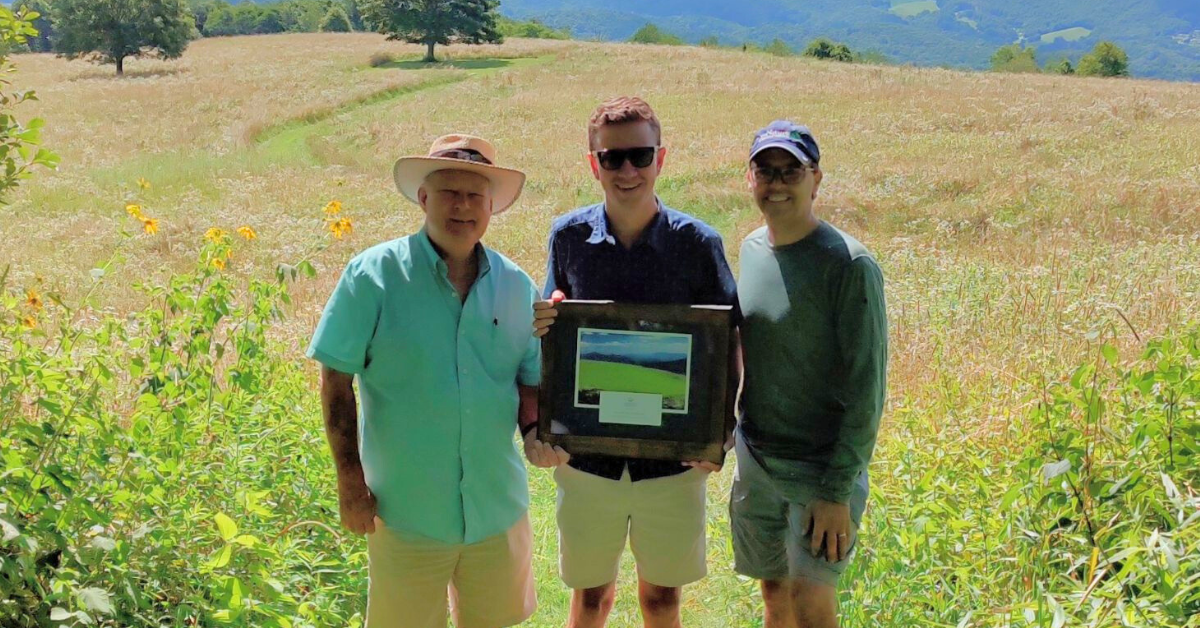
Picture Caption: Land for Tomorrow Coalition representatives recognized Senator Brent Jackson as a North Carolina Land and Water Champion at Big Yellow Mountain Preserve. Senator Jackson was a critical leader in passing the NC Farm Act, SB 355, which includes the return of the conservation tax credit. Pictured from left to right: Sen. Jackson, Will Morgan, and Will Robinson.

ABOUT LAND FOR TOMORROW COALITION:
Land for Tomorrow is a statewide coalition of community leaders, conservation and wildlife organizations, and parks and recreation advocates with a common goal: increasing land and water conservation in North Carolina.

Unanimous Support for the NC Farm Act Benefits Working Farms, Forests, and Trails

Land for Tomorrow praises the North Carolina’s General Assembly and Governor for passing the NC Farm Act, SB 355, which includes the return of a pivotal tax credit for land conservation.

The Farm Act passed unanimously 104-0 in the House and 40-0 in the Senate. Senator Brent Jackson (R-Sampson) was a critical leader in the success of this bill. He issued the following statement:

“I am honored to work on this legislation on behalf of North Carolina farmers. Agriculture is North Carolina’s No.1 industry, and it is critical that we do all we can to support all the families who depend on agriculture to support their livelihood. We are all touched by agriculture daily, and this legislation shows the General Assembly’s commitment to protecting agriculture in North Carolina today and for generations to come.”

Governor Roy Cooper issued the following statement on signing the bill on July 3, 2024:

“The conservation tax credit I proposed in my budget and passed into law with this bill will help us reach the goal I set of permanently conserving one million new acres of natural lands by 2040. Protecting forests, wetlands, and farmlands makes us more resilient to climate hazards, reduces carbon in our atmosphere, promotes military readiness, and supports local economies.”

The conservation tax credit included in the Farm Act is a time-limited NC tax policy that allows for a state tax credit on the value of real estate donated to a qualified nonprofit or government entity for farmland preservation, public trails, fish and wildlife, and other conservation-related purposes. The property must be donated within two years, between January 1, 2025, and December 31, 2026. There are other limitations on the tax credit. Landowners should consult with tax professionals if they’re interested in taking advantage of the tax credit opportunity.

The conservation tax credits are a powerful incentive for private landowners to conserve more farm and forest land and expand our state’s parks, trails, and wildlife areas. Neighboring states, including Virginia, South Carolina, and Georgia, also provide this incentive to conserve land.

North Carolina previously had this incentive, and in the ten years of the program, it helped encourage landowners to conserve 238,000 acres across the state. When the program ended on December 31, 2013, our state saw a steep decline in the number of projects conserved and acres protected.

Providing incentives like the Conservation Income Tax Credit to private landowners will increase the number of conservation projects and reduce acquisition costs for state, local, and private agencies.

“Preserving North Carolina’s working farms, forests, and trails is more important than ever as our state continues to grow. Putting a conservation tax credit in place couldn’t come at a better time,” said Kevin Redding, director of Piedmont Land Conservancy and chair of the Coalition. “Thanks to Sen. Brent Jackson, Rep. Jimmy Dixon, Rep. Steve Ross, Rep. Michael Wray, and Agriculture Commissioner Troxler for their leadership on this effort.”

“Passing this bill puts us in line with South Carolina, Georgia, and Virginia, which all have similar state tax credit policies,” said Tim Gestwicki, Chief Executive Officer of the North Carolina Wildlife Federation. “Hunting and fishing are a way of life in North Carolina. The conservation tax credit helps us in our work to secure our fish and wildlife for future generations by providing landowners with an incentive to protect their property permanently.”

Land for Tomorrow is a statewide coalition of community leaders, conservation and wildlife organizations, and parks and recreation advocates who share the goal of increasing land and water conservation in North Carolina.

Funding is Needed to Meet Public Demand

The public demand for outdoor recreation opportunities continues to grow in North Carolina.

Over 20,100,000 people visited NC State Parks in 2023 – a 4% increase over 2022. The statewide 2023 Year of the Trail successfully promoted our network of hiking, paddling, biking, and equestrian trails.

The Made X Mountains Partnership recently released the results of the Western North Carolina Outdoor Recreation Participation Survey, which found that outdoor recreation generated $4,900,000,000 in economic input, 48,000 full-time jobs, and $197,500,000 in local tax revenues just in 25 western North Carolina counties.

Conserving our land means success for our state.

Land for Tomorrow recommends the following and looks forward to working with the General Assembly to bolster the conservation of North Carolina’s natural places and working farms.

  • NC Land & Water Fund
    Increase funds to:

    • $30,000,000 recurring
    • $10,000,000 in non-recurring funds for FY 24-25
  • Parks & Recreation Trust Fund
    Increase funds to:

    • $30,000,000 recurring
    • $10,000,000 in non-recurring funds for FY 24-25
  • Agricultural Development & Farmland Preservation Fund
    We appreciate Commissioner Troxler’s strong support for farm and forestland conservation, and we support his requests.
    Increase funds to:

    • $10,000,000 recurring
  • Conservation Income Tax Credit
    Land for Tomorrow strongly supports H290, Protecting NC’s Military and Working Lands. H290 provides a powerful incentive for private landowners to conserve their land and to sell or donate land or easements at a discount.
  • Requests for Additional Staff
    Land for Tomorrow supports requests by the Department of Natural & Cultural Resources, Wildlife Resources Commission, and Department of Agriculture for additional staff to manage new and expanded state parks, state trails, historic sites, wildlife management areas, and state forests.

Click here to download a PDF of our priorities for 2024.

To learn more about the impact of the conservation trust funds and see your tax dollars in action, follow Land for Tomorrow on Facebook – https://www.facebook.com/L4TNC – and Twitter – https://twitter.com/land4tomorrow – as well as LinkedIn – https://www.linkedin.com/company/land-for-tomorrow.

Land for Tomorrow is a statewide coalition of community leaders, conservation, and wildlife organizations, and parks and recreation advocates with a common goal: increasing land and water conservation in North Carolina.

Conservation Wins Big in 2023 Budget

The North Carolina Land for Tomorrow Coalition is praising the 2023 state budget, which will pump more than $100 million per year into land and water conservation.

“Protecting land and water is vital to many of the state’s most important industries, including agriculture, tourism, forestry, and the military,” said Bill Holman, NC State Director for The Conservation Fund and chair of the Coalition. “Increasing access to parks, trails, and greenways will help keep North Carolina a great place to live, work, and play. We all owe the General Assembly, Agriculture Commissioner Steve Troxler, and Governor Cooper a big thank you.”

“North Carolina is growing fast, and this funding is absolutely essential to protect land and water for future generations,” said Tim Gestwicki, Chief Executive Officer of the North Carolina Wildlife Federation. “In particular, this budget will help keep many acres of working lands in production by offering additional funding for our state’s farmers, ranchers, foresters, and others who are stewarding their lands for the good of us all.”

The state’s three conservation trust funds, the North Carolina Land and Water Trust Fund (NCLWF), the Parks and Recreation Trust Fund (PARTF), and the Agricultural Development and Farmland Preservation Trust Fund (ADFPTF) are essential tools that allow state agencies and nonprofit partners to protect North Carolina’s valuable natural resources.

Conservation funding in the budget includes:

  • Increases recurring funding for the NC Land and Water Fund by $3.8 million, and provides an additional $2 million in nonrecurring funds, bringing the total funding to $30 million.
  • Increases recurring funding for the Parks and Recreation Trust Fund by $3.8 million, and provides an additional $2 million in nonrecurring funds, bringing the total funding to $30 million.
  • Increases funding for the Agriculture Development and Farmland Preservation Trust Fund by $10 million, bringing the total funding to $20 million.
  • Provides $42 million over the biennium for trails, including $25 million for the Great Trails Program, $5 million for the Complete the Trails fund, and $12 million for the Saluda Grade Trail.
  • Provides $12.5 million for the development of local parks that provide access for people with disabilities.

Land for Tomorrow is a statewide coalition of community leaders, conservation, and wildlife organizations, and parks and recreation advocates with a common goal: increasing land and water conservation in North Carolina.

Haw River Trail Becomes a State Trail

The local favorite joins 12 other distinguished trails across the state.

The Haw River Trail is now an authorized state trail thanks to the perseverance of local advocates, nonprofit organizations, and North Carolina legislators Representative Stephen M. Ross, Senator Amy S. Galey, and Representative Dennis Riddell.

“The Haw River State Trail is a lasting tribute to the power of the community. Dozens of landowners in Alamance County have shared their private property so that everyone can enjoy the beauty and power of the Haw,” said Brian Baker, Assistant County Manager of Alamance County. “Thanks to that commitment, the Haw River has regained its place as the heart of Alamance County.”

The Haw River Trail provides public access to one of North Carolina’s most important natural features. The land and paddle trail allows the community to explore while helping to conserve and protect this vital resource. Local nonprofits Friends of Lower Haw River State Natural Area, Carolina Canoe Club, and The Conservation Fund were critical in orchestrating behind the scenes to make this authorization possible. Both the Alamance and Chatham counties’ board of commissioners adopted resolutions supporting state trail authorization.

“Adding this beloved trail to the state trails program is a special opportunity for Alamance County,” said Representative Ross. “It is a great place to hike and paddle and enjoy the outdoors. Conserving places like the Haw River Trail also gives us cleaner air and cleaner water which will benefit our state for decades to come.”

The Haw River Trail will join 12 other state trails and become part of the North Carolina State Parks system. While a state park is operated and managed by the Division of Parks and Recreation, a state trail comprises multiple connected sections that rely on local partnerships. Each section of the trail is sponsored by a federal, state or local government agency, nonprofit organization, or private landowner.

“State trail status gives the Haw River recognition across North Carolina as a trail of statewide significance,” said Senator Galey. “The state trail designation welcomes attention and economic benefit from tourism and recreation to Alamance County and beyond. The families of North Carolina have a beautiful place to splash and play for future generations.”

The Haw River Trail boasts:

  • 20 miles of completed land trail in Alamance County
  • 40 miles of completed paddle trail in Alamance County
  • 15 recreational parks and trailheads open along the trail in Alamance County
  • 6 public access sites in Chatham County

“It’s the commitment of our North Carolina’s General Assembly to the state’s conservation trust funds that make efforts like this one possible,” said NC State Director of The Conservation Fund Bill Holman, who chairs the Land for Tomorrow Coalition. “We’re also thankful to Representative Ross for being the primary sponsor of a conservation tax credit bill that will soon pass as part of the House budget. Investment in our natural spaces ensures that residents can enjoy and explore all that North Carolina has to offer.”

The planned Haw River Trail corridor extends approximately 80 miles along the Haw River, from Haw River State Park on the Rockingham-Guilford County line through Alamance County to Jordan Lake State Recreation Area in Chatham County. Public access to the Haw River Trail in Chatham County is provided at the Lower Haw River State Natural Area, owned by State Parks and by three public access sites managed by Chatham County Parks and Recreation. The trail in Alamance County is part of the statewide Mountains-to-Sea Trail, allowing hikers to travel across the state from Clingman’s Dome in the west to Jockey’s Ridge in the east.

Learn more about:

Prioritizing land and water conservation

Thank you to North Carolina’s governor and legislators for passing a budget that prioritizes land and water conservation. Funding of $48.4 million to the state’s conservation trust funds will benefit people and nature for generations.

Our state’s conservation needs are not one-and-done. The Land for Tomorrow coalition thanks our state leadership for building on the foundation of conservation funding established in 2021. By securing reoccurring funding, every generation now has a chance to have clean air and water as well as beautiful places to play.

Land and water are North Carolina’s most important economic assets. The four engines of North Carolina’s economy – agriculture, tourism, forestry and the military – depend on land and water conservation. Therefore, protecting these vital natural resources is essential to North Carolina’s bottom line – boosting spending and providing jobs.

Our state’s conservation trust funds ensure that the North Carolina Land and Water Trust Fund (NCLWF), Parks and Recreation Trust Fund (PARTF), and the Agricultural Development and Farmland Preservation Trust Fund (ADFPTF) are fully funded to be the safeguards for our state. In addition, these funds enable conservation groups to continue working with state agencies to protect North Carolina’s valuable natural resources, ensuring that both current and future generations will continue to benefit from all our state has to offer.

Thank you to the governor and our legislators for conservation funding of the following:

  • Increases recurring funding for the North Carolina Land and Water Fund by $11 million, taking the total recurring funding from $13.2 million to $24.2 million.
  • Increases recurring funding for the Parks and Recreation Trust Fund by $8 million, taking the total recurring funding from $16.2 million to $24.2 million.

To learn more about the impact of the conservation trust funds and see your tax dollars in action, follow Land for Tomorrow on Facebook – https://www.facebook.com/L4TNC – and Twitter – https://twitter.com/land4tomorrow.

Cooper’s Budget Works to Protect Our State’s Land and Water

The Land for Tomorrow coalition praised Governor Cooper’s proposed budget, which increases appropriations to the state’s conservation trust funds and provides additional funding for building resilient communities.

“It’s clear that our citizens want to protect our land and water, from the coast to the mountains. We applaud Governor Cooper for responding to that desire with a sound budget proposal,” said Bill Holman, NC State Director for The Conservation Fund and chair of the Land for Tomorrow Executive Committee. “Land and water conservation are important to North Carolina’s economy. In the last budget, we saw support for conservation on both sides of the aisle. This is a good beginning for another budget that protects our state’s natural resources for our communities and allows tourism and agriculture to thrive. We look forward to working with the N.C. General Assembly on a final budget that supports protecting our land and water.”

The highlights of Governor Cooper’s budget for natural and working lands and building more climate resilience:

  • Parks and Recreation Trust Fund (PARTF): Provides an additional $3,757,116 recurring and $20 million nonrecurring to the Department of Natural and Cultural Resources (DNCR) for projects in state parks, the development and renovation of local parks, and beach access. In FY 2022-23, the total funding is $40 million.
  • North Carolina Land and Water Fund (NCLWF): Provides $6,842,470 recurring and $20 million nonrecurring to DNCR to support NCLWF grants to protect and restore the state’s land and water resources, preserve military buffers, restore degraded streams, and develop and improve stormwater treatment. In FY 2022-23, the total funding is $40 million.
  • Peatland and Pocosins Conservation and Inventory: Provides $10 million nonrecurring to DNCR for peatlands and pocosins acquisition and restoration to reduce carbon emissions and wildfire risk, provide flood resilience, and improve water quality. DNCR’s Natural Heritage Program will inventory Coastal Plain wetlands not previously included in natural heritage inventories to inform acquisition and restoration efforts.
  • Resilient Communities Grant Program and Resiliency Staff: Provides $762,825 recurring and $10 million nonrecurring to the Department of Environmental Quality (DEQ) and the NC Office of Recovery and Resiliency (NCORR) within the Department of Public Safety (DPS) for core resiliency staff, to expand the program to additional communities, and to provide grants, enabling regions and local governments to reduce flood risk and promote long-term resilience.
  • Swine Floodplain Buyout Program: Provides $18 million nonrecurring funding to the Department of Agriculture and Consumer Services (DACS) to purchase permanent conservation easements on properties currently used for swine production that are within the 100-year floodplain.
  • Forest Development Program: Provides $2 million in one-time funding to DACS for cost-share assistance to NC landowners to improve forest management on private lands through landowner outreach, tree plants, and technical support to adopt and follow best practice management plans.
  • Coastal Habitat Assessment Program: Provides $720,526 recurring and $122,500 nonrecurring to DEQ to establish the Coastal Habitat Assessment Program. This program will assess coastal habitats through site mapping, vegetation assessments, and observation of wetland changes over time.

READ THE FULL BUDGET HERE: https://www.osbm.nc.gov/media/2575/open

Land for Tomorrow is a statewide coalition of community leaders, conservation, and wildlife organizations, and parks and recreation advocates with a common goal: increasing land and water conservation in North Carolina.