Bipartisan Majority of U.S. Senate Sponsors Legislation to Provide Full Dedicated Funding for LWCF

56 Senators Support Great American Outdoors Act

WASHINGTON – With the support of President Donald J. Trump and 56 bipartisan members of the U.S. Senate, Senators Cory Gardner (R-CO) and Joe Manchin (D-WV) introduced new legislation that will provide full dedicated funding for the Land and Water Conservation Fund (LWCF).  The Great American Outdoors Act advances two critical priorities from previously introduced bills – in addition to fully funding LWCF, it also addresses the maintenance backlog in America’s national parks and other public lands.

“This legislation makes clear the broad, bipartisan commitment to LWCF and its importance to conservation and outdoor recreation efforts across the country.  The Great American Outdoors Act represents a historic opportunity for Congress to make critical and lasting investments in our public lands and the outdoor recreation economy,” said Tom Cors, Director of Government Relations for Lands at The Nature Conservancy and a spokesman for the LWCF Coalition.

“The LWCF Coalition applauds Senators Gardner and Manchin – supported by the majority and minority leaders, and by our many other dedicated champions in the Senate – for standing up on behalf of millions of outdoorsmen and women to get the job done for LWCF this year.  We look forward to working with the House and Senate to get this over the finish line as soon as possible,”

About the Land and Water Conservation Fund 

The Land and Water Conservation Fund is America’s most important conservation program, responsible for protecting parks, wildlife refuges and recreation areas at the federal, state and local level.  For 50 years, it has provided critical funding for land and water conservation projects, recreational construction and activities and the continued historic preservation of our nation’s iconic landmarks from coast-to-coast.

LWCF does not use any taxpayer dollars – it is funded using a small portion of revenues from offshore oil and gas royalty payments. Outdoor recreation, conservation and historic preservation activities contribute more than $887 billion annually to the U.S. economy, supporting 7.6 million jobs.

About the LWCF Coalition

The LWCF Coalition is the umbrella group of more than 1,000 state and local land owners, small businesses, ranchers, sportsmen, veterans, outdoor recreationists and conservation organizations working to protect America’s public lands and safeguard our shared outdoor heritage for future generations.

The Coalition is united in its advocacy for full funding of the Land and Water Conservation Fund, which will ensure the continued conservation of our national parks, forests, wildlife refuges, wilderness, civil war battlefields, as well as state and local parks.

For more information on LWCF and the places in each state that have been protected using LWCF funds, visit www.lwcfcoalition.com

###

RELEASE: March 10, 2020 

Media Contact: Justin Bartolomeo (202) 789-4365
 

CWMTF Surplus in Grant Requests

With the start of a new grant cycle for the Clean Water Management Trust Fund (CWMTF), conservation organizations, local parks agencies, and others submitted applications to fund conservation projects across the state.

A total of 144 grant applications were submitted to North Carolina’s Clean Water Management Trust Fund, totaling $82,613,060. That’s about five times more than the allocated $16,565,670 for projects in 2019. Without adequate funds appropriated to the CWMTF in 2020, many of the proposed projects could lack the necessary funding for completion.

Ensuring there are ample funds allocated toward conservation efforts is necessary for North Carolina’s economic and future development. Of the 144 applications, 100 of them are requests for funding land acquisitions, which protect North Carolina’s natural beauty and resources such as water, animal habitats and plant species unique to our state. The other 44 submissions are for restoration, innovative stormwater solutions, and planning projects.

As North Carolina continues to invest in building a more resilient state, lawmakers must also prioritize the appropriation of adequate funding for land and water conservation projects that benefit citizens today and into the future. The need for conservation funding through CWMTF and other avenues is great and impacts every district and every resident. We must continue ensuring that our trust funds are well protected and adequately funded.

To view the full list of the 2020 CMWTF requests, click here.

Conservation Champion: Representative Kyle Hall

Representative Kyle Hall has worked on conservation efforts that benefit the quality of life and economic well-being for residents in North Carolina. Land for Tomorrow asked Representative Hall a few questions about the importance of land protection in our state.

1. Where is your favorite natural/outdoor place in North Carolina and why is it important to you?

I’m blessed to have three of the best state parks in the 91st District: Hanging Rock, Pilot Mountain, and Mayo River State Parks. I regularly visit them on the weekends for outdoor recreation and to simply clear my head after hectic weeks in Raleigh.

2. What do you see are the immediate and long-term benefits of investing in land protection?

Conservation helps to improve the quality of life for our state’s future generations. It is also an economic development tool as potential new businesses and visitors are looking at states with a higher quality of life.

3. How can land protection have an overall economic impact on North Carolina’s constituents and state economy through the tourism, agricultural and farming, and military divisions?

North Carolina competes for new jobs and tourism dollars. Businesses are looking for states with reduced tax burdens and higher quality of life. Tourists are looking for states with plenty to see and do. Our state is fortunate to offer new businesses and visitors not only a competitive tax climate but also majestic mountains, thriving cities and tranquil beaches, something most other states cannot deliver. Conserving our natural assets is just one more tool in the job recruitment toolbox.

4. Why is conservation funding important to your constituents? How do you feel the investment in land can generate a direct, positive impact in your respective district?

In the 91st District, it’s easy to see a direct correlation between conservation and increased economic activity. For example, Hanging Rock and Pilot Mountain each had nearly 800,000 visitors last year. Those visitors ate at our local restaurants, made purchases at our local shops, and stayed in our campgrounds and hotels. This return on investment is huge for rural communities like mine.

5. What are your suggestions as to how community members, local and state government officials, and land conservation groups can work together to support land conservation in North Carolina?

Conservation groups should meet regularly with local elected officials, local business owners, and outdoorsmen to establish long term plans for their local areas and be cognizant that there must be local buy-in for these long-term goals.

6. What do you see as the biggest threat facing North Carolina’s land conservation efforts?

A lack of private investment and an inability to spend money wisely.

The Conservation Champion series intends to highlight North Carolina legislators dedicated to protecting our state’s natural resources and display why funding conservation projects is important for our state’s development.

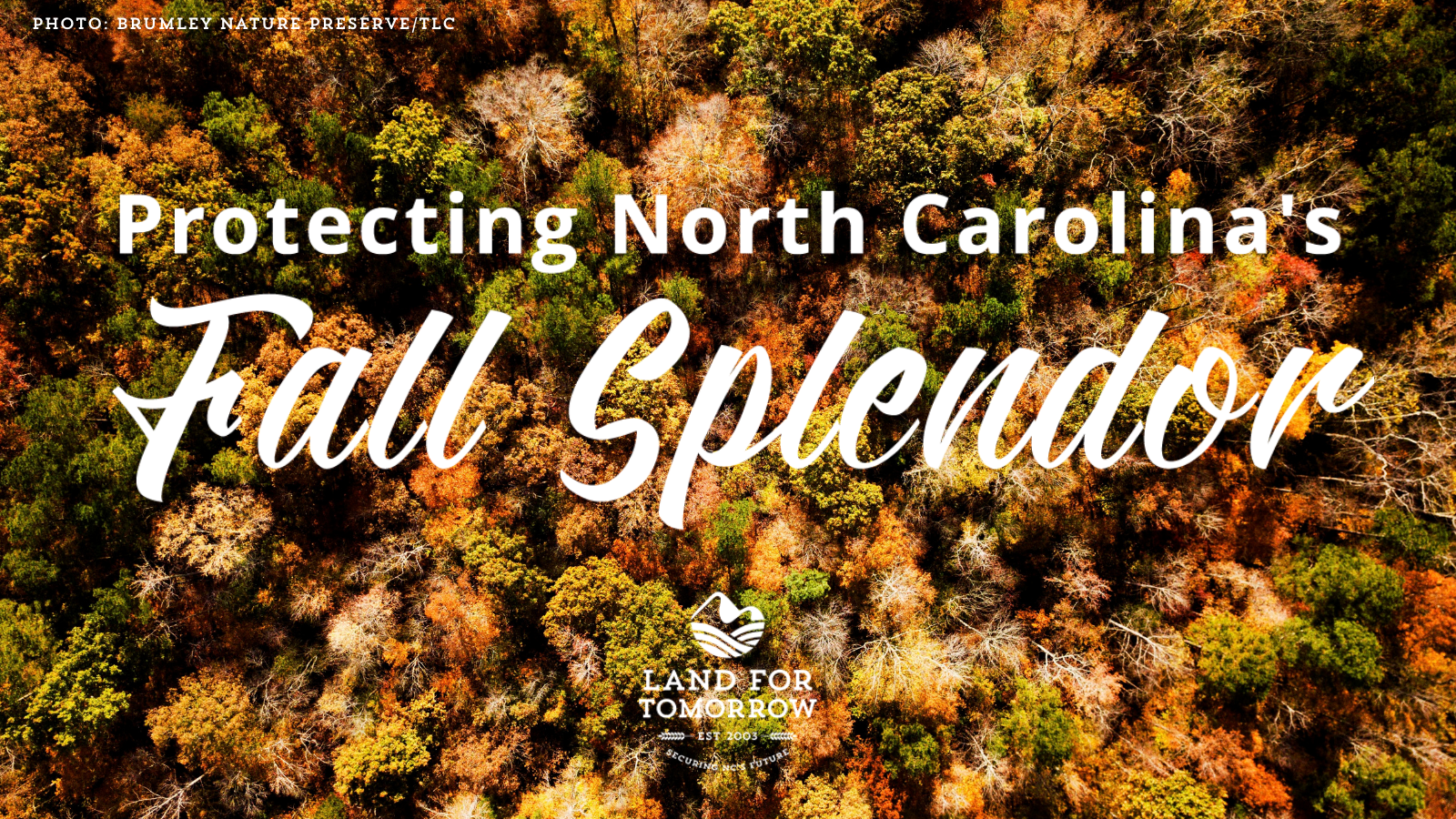
Protecting North Carolina’s Fall Splendor

Cooler temperatures mean North Carolinians can finally get outside and safely enjoy the glory of this fall leafing season.

Each of the following locations are protected and open to visitors thanks to the hard work of local organizations and North Carolina’s conservation trust funds – the N.C. Land and Water Fund (NCLWF), Parks and Recreation Trust Fund (PARTF) and/or the Agricultural Development and Farmland Preservation Trust Fund (ADFPTF). The conservation trust funds help ensure that we all have access to clean air, clean water and spectacular places to recreate and relax.

Plan your next socially distanced fall hike at one of these splendid getaways:

Mountains

Foothills

Piedmont

Triangle

Coast

Charlotte

Conservation Champion: Senator Andy Wells

Senator Andy Wells has been an avid supporter of legislation that benefits conservation funding in North Carolina. Land for Tomorrow asked Senator Wells a few questions about the importance of land protection.

1. Where is your favorite natural/outdoor place in North Carolina and why is it important to you?

Jacob’s Fork River in Catawba County is my favorite natural place in North Carolina. It’s still pristine after the brief journey from South Mountain State Park – less than an hour from Charlotte – still undiscovered. I’m lucky, it’s 20 minutes from my Hickory office to a more peaceful world.

2. What do you see are the immediate and long-term benefits of investing in land protection?

Land protection, water quality, storm resiliency, and mitigation all go hand-in-hand, and the combined benefits add up to help local communities. Addressing all these holistically will preserve more land at less cost to taxpayers.

3. How can land protection have an overall economic impact on North Carolina’s constituents and state economy through the tourism, agricultural and farming, and military divisions?

Too often, governments distort free markets. Bad zoning policy or bad tax policy do that. Bad policies can be the result of special interest lobbying or good old-fashioned poor judgement. And they can encourage landowners to make choices based on short-term profits. Our ancestors knew that their children would inherit land only as good as they passed along. Preservation is a way to balance the scales and replace short-term with long-term thinking.

4. Why is conservation funding important to your constituents? How do you feel the investment in land can generate a direct, positive impact in your respective district?

As Chairman of the Senate Agriculture, Environment, and Natural Resources Committee, my responsibilities cover the state – from protecting family farms to local parks or major rivers. Taking time away from digital computer screens and enjoying the nature created for us by God is a blessing we should all appreciate.

5. What are your suggestions as to how community members, local and state government officials, and land conservation groups can work together to support land conservation in North Carolina?

Agree to a long-term and fair goal for communities across the state, have a plan to work toward that goal and execute the plan.

6. What do you see as the biggest threat facing North Carolina’s land conservation efforts?

A fragmented bureaucratic structure that fails to spend taxpayers’ money wisely and efficiently.

The Conservation Champion series intends to highlight North Carolina legislators dedicated to protecting our state’s natural resources and display why funding conservation projects is important for our state’s development.

Register for Lobby Day 2019 – April 16

Land for Tomorrow will host it’s annual Land and Water Conservation Lobby Day on Tuesday, April 16.

Register today! 

NEW MORNING LOCATION! Lobby Day will begin with a Welcome Briefing at the NC Museum of Natural Sciences, 11 W. Jones St, Raleigh, NC 27601, 4th Floor Environmental Conference Room.

We will again offer a Pre-Lobby Day Orientation Webinar to be held on Friday, April 12 at 11:00 am to prepare our advocates with guidance on Land for Tomorrow’s 2019 legislative agenda and to answer frequently asked questions about the event.

We look forward to having you join us in Raleigh to advocate for land and water conservation that’s critical to your organization and region of the state.

Cooper’s Budget Makes Strong Commitment to Land and Water Conservation

The Land for Tomorrow coalition praised Gov. Cooper’s proposed budget, which increases appropriations to the state’s conservation trust funds and provides additional personnel for the state park system.

“Land and water conservation are important to North Carolina’s economy,” said Bill Holman, NC State Director for the Conservation Fund and chair of the Land for Tomorrow Executive Committee.  “Tourism, agriculture, and the military are all dependent on land and water conservation. That’s the reason that conservation has always been supported by both sides of the aisle. This is a good beginning; we look forward to working with the N.C. General Assembly on a final budget that supports conservation.”

Gov. Cooper’s budget:

  • Increases recurring appropriations to the Clean Water Management Trust Fund (CWMTF) by $6.8 million and a one-time appropriation of $5 million. CWMTF’s 2019 total appropriation would be $25 million.
  • Increases recurring appropriations to the Parks and Recreation Trust Fund (PARTF) by $3.7 million and a one-time appropriation of $5 million. PARTF’s 2019 total appropriation would be $25 million.

The governor’s budget recommends $1.75 million to hire additional park staff who will work at new park facilities that were funded by Connect NC Bonds that were approved by North Carolina voters three years ago. It also recommends several additional trail projects and a continued partnership with Conservation Corps in the state park system.

Land for Tomorrow is a statewide coalition of community leaders, conservation, and wildlife organizations, and parks and recreation advocates with a common goal: increasing land and water conservation in North Carolina.

###

RELEASE: March 7, 2019 

Media Contact: Debbie Crane (919) 794-4373 

3/6/19 — Support House Bill 14: Reconstitute Various Boards and Commissions

SITUATION:

We’re working to SUPPORT House Bill 14: Reconstitute Various Boards and Commissions.

As you may recall, these two boards, along with four others, were the subject of litigation, which was only recently resolved.  However, there is still some ongoing uncertainty regarding the appointments to these two boards. Legislation is needed to bring the boards into compliance with those court decisions.

SOLUTION:

Our request is that House members hear the bill to fix these boards as soon as possible.  The language in House Bill 14 would provide an immediate fix to these boards and would allow CWMTF and PARTF to continue their important work.

SAMPLE EMAIL:

Dear Representative,

I write to ask for your support for House Bill 14, which permanently fixes the constitutional defects in the Clean Water Management Trust Fund (CWMTF) and the Parks and Recreation Trust Fund (PARTF). As you know, these trust funds are critical to the work our organization does in our region of the state, and currently our highest priority is getting these boards fixed to resolve any ongoing uncertainty.

As you may recall, these two boards, along with four others, were the subject of litigation, which was only recently resolved.  However, there is still some ongoing uncertainty regarding the appointments to these two boards. Legislation is needed to bring the boards into compliance with those court decisions.

House Bill 14, which is cosponsored by Representatives McGrady, Torbett, Ross, and Harrison, would fix all six boards in question, including CWMTF and PARTF.  The bill has been referred to Judiciary and State/Local Government, however the bill hasn’t been calendared for a hearing yet. I would appreciate you reaching out to the Judiciary Committee Chairs, Rep. Davis and Rep. Stevens, to let them know you support this bill, and to ask them to hear the bill as soon as possible.

Thank you for your ongoing support for local parks and recreation, state parks, and land and water conservation.

SAMPLE SOCIAL:

  • #NCGA please SUPPORT HB 14 so the #CWMTF and #PARTF boards can be fixed. This bill provides the solution we need to protect North Carolina’s beautiful spaces, clean water and clean air.#ncpol
  • #NCGA please support House Bill 14 to provide a fix to the conservation trust fund boards that would allow these funds to continue their important work. #ncpol

12/18 — Senate Bill 821 (Sunset Unconstitutional Boards and Commissions)

SITUATION:

We’re working to OPPOSE Senate Bill 821 (Sunset Unconstitutional Boards and Commissions). This bill is damaging to the Clean Water Management Trust Fund and the Parks and Recreation Trust Fund because:

  • While the six boards and commissions listed in the bill were recently found unconstitutional, this bill does not fix the problem.
  • Conservation groups will be hesitant to start new conservation projects without knowing that there will be boards in place next year,
  • The appropriations committees will be reluctant to appropriate funds to these trust funds with this cloud of uncertainty hanging over them.

SOLUTION:

Our request is that legislators fix these boards as soon as possible.  The language in House Bill 1120 (Reconstitute Various Boards and Commissions) would provide an immediate fix to these boards and would allow CWMTF and PARTF to continue their important work.

SAMPLE EMAIL:

Dear Representative,

I’m reaching back out to you regarding the various pieces of legislation that would sunset six different boards and commissions, including the Clean Water Management Trust Fund and the Parks and Recreation Trust Fund.  As you know, those two trust funds are absolutely critical to the work that we do in our part of the state.  These trust funds have enjoyed overwhelming bipartisan support over the last few legislative sessions, and have in fact received increases almost every year for the last six years thanks to support from members like you.

It is my understanding that Senate Bill 821 (Sunset Unconstitutional Boards and Commissions) is currently being considered by the North Carolina House of Representatives.  I respectfully request that you oppose this piece of legislation.  While the six boards and commissions listed in the bill were recently found unconstitutional, this bill does not fix the problem, and instead it kicks the can down the road.  I’m concerned that not fixing these boards now will create a chilling effect on the important work of these trust funds.  Conservation groups like ours will be hesitant to start new conservation projects without knowing that there will be boards in place next year, and I’m concerned that your appropriations committees will be reluctant to appropriate funds to these trust funds with this cloud of uncertainty hanging over them.  For those reasons, I would request that you fix these boards as soon as possible.  The language in House Bill 1120 (Reconstitute Various Boards and Commissions) would provide an immediate fix to these boards and would allow CWMTF and PARTF to continue their important work.

I appreciate your ongoing support for conservation, and for the reasons stated above, I hope that you will oppose S821, and instead pass the language in H1120 so that the Clean Water Management Trust Fund and Parks and Recreation Trust Fund can continue their important conservation work across our state.

SAMPLE SOCIAL:

  • #NCGA please OPPOSE NCSB 821 — Sunset Unconstitutional Boards and Commissions. This bill is damaging to the Clean Water Management Trust Fund and the Parks and Recreation Trust Fund that protect North Carolina’s beautiful spaces, clean water and clean air.#ncpol
  • #NCGA please support House Bill 1120 — Reconstitute Various Boards and Commissions —  to immediate fix to the conservation trust boards and would these funds to continue their important work. #ncpol

Carteret County News-Times: Thank you Rep. McElraft

A letter to the Carteret County News editor praising Representative McElraft’s leadership to fund the conservation trust funds.

TO THE EDITOR:

Thanks to the support of North Carolina Rep. Pat McElraft, family farms in eastern North Carolina will be preserved, military bases will be protected from encroaching development and North Carolinians will have more opportunities for outdoor recreational activities in the future.

The recently passed budget includes $22.7 million in additional money for the state’s conservation trust funds, including an additional $14.7 million for preserving working farms near military bases. Not only will this help protect our natural resources but will aid in the further development of our state’s economy.

As chair of the House Agriculture and Natural and Economic Resources Appropriations Committee, Rep. McElraft has been a strong supporter of funding for parks and recreation projects. She has been an advocate for restoring dedicated funding for the conservation trust funds and coastal storm damage mitigation funds. She has demonstrated her commitment to protecting our agricultural heritage and natural resources to make North Carolina a great place to live, work and visit.

In backing efforts to benefit North Carolinians, Rep. McElraft continues to show her dedication to the people of our state. We must continue to promote and develop our outdoor recreation and tourism industries, protect our military bases and increase our efforts to conserve water and land if we hope to uphold a North Carolina that future generations can be proud to call home. I believe Rep. McElraft will continue to be a key leader on these issues and thank her for her efforts.

Jane Rouse, Morehead City

Originally published on November 17, 2018.